Understanding Your Commercial Water Bill: CCF Rates, Tier Structures & Hidden Charges Explained
Complete guide to reading your commercial water bill. Learn what CCF means, how tiered water rates work, and where hidden charges inflate your bill by 15-30%. Includes CCF-to-gallon conversion tables.
Key Takeaway
CCF (Centum Cubic Feet) is the standard billing unit for commercial water — 1 CCF = 748 gallons. The average U.S. commercial water rate ranges from $5.50-$9.00 per CCF in 2026, but tiered rate structures can push effective costs to $15-$25/CCF for high-volume users. Understanding your bill line-by-line reveals hidden charges that typically inflate total costs 15-30% beyond volumetric water charges alone.
What Does CCF Mean on Your Water Bill?
CCF stands for Centum Cubic Feet — literally "100 cubic feet." It's the standard unit most U.S. water utilities use to measure consumption. If your meter reads in CCF, each unit represents exactly 748 gallons.
Some utilities bill in kGal (thousands of gallons) instead. The conversion is straightforward: 1 CCF = 0.748 kGal, or roughly 1 CCF ≈ ¾ of a kGal.
CCF-to-Gallon Quick Reference
| CCF | Gallons | kGal | Typical User |
|---|---|---|---|
| 1 | 748 | 0.75 | Single household per week |
| 10 | 7,480 | 7.48 | Small restaurant monthly |
| 50 | 37,400 | 37.4 | Mid-size office building |
| 134 | 100,000 | 100 | Hotel / multifamily |
| 400 | 299,200 | 299.2 | Large commercial facility |
Average Water Cost Per CCF in 2026
The national average combined (water + sewer) rate for commercial properties is approximately $12.50 per kGal or $9.35 per CCF in 2026. However, rates vary enormously by city:
| City | Water/CCF | Combined/CCF | vs. National Avg |
|---|---|---|---|
| San Francisco, CA | $10.27 | $15.40 | +65% |
| Baltimore, MD | $8.60 | $13.22 | +41% |
| Cleveland, OH | $7.88 | $11.95 | +28% |
| Minneapolis, MN | $6.12 | $10.22 | +9% |
| Memphis, TN | $2.80 | $5.45 | -42% |
How Tiered Water Rates Work (And Why They Cost You More)
Most municipalities use tiered (inclining block) rate structures that charge more per unit as consumption increases. This means commercial properties — which naturally use more water than residential — often pay 40-60% more per CCF than the base rate suggests.
Example: How Tiers Escalate (Typical 3-Tier City)
- • Tier 1 (0-10 CCF): $4.50/CCF — baseline rate
- • Tier 2 (11-50 CCF): $7.25/CCF — 61% above Tier 1
- • Tier 3 (51+ CCF): $11.80/CCF — 162% above Tier 1
A facility consuming 100 CCF pays $4.50 for the first 10, $7.25 for the next 40, and $11.80 for the final 50 — an effective blended rate of $8.97/CCF, nearly double the Tier 1 price.
Anatomy of a Commercial Water Bill: Line by Line
Understanding each line item reveals where the hidden costs are:
1. Water Service Charge (Fixed)
Monthly base fee regardless of usage, based on meter size. A 2" commercial meter can cost $50-$200/month just for the connection.
2. Volumetric Water Charges
The per-CCF charge for actual water consumed. This is what tiers affect. Typically 30-40% of your total bill.
3. Sewer / Wastewater Charges
Calculated at 80-100% of metered water volume. Often equals or exceeds the water charge. This is the most commonly overlooked cost multiplier.
4. Stormwater / Infrastructure Fees
Flat or impervious-area-based fees for stormwater management. Can add $25-$150/month for commercial properties.
5. Municipal Surcharges
Infrastructure levies, environmental fees, consent decree pass-throughs. Baltimore adds a 15.5% surcharge for wastewater consent decree compliance.
The Hidden Cost: Air in Your Water Lines
One of the most overlooked causes of inflated commercial water bills is dissolved air. Municipal water supply lines carry 2-5% air by volume. When this air reaches your meter, it expands (following Boyle's Law — as pressure drops at the meter, air volume increases) and the meter registers it as water consumption.
For a facility using 300 kGal/month at $12.50/kGal combined, a 5% air-related overcharge means $2,250/year in phantom water charges — water you never actually used.
How Much Air Is Inflating Your Bill?
Use our free ROI calculator to see your facility's potential savings from smart valve technology.
Calculate Your Savings →5 Ways to Lower Your Commercial Water Bill
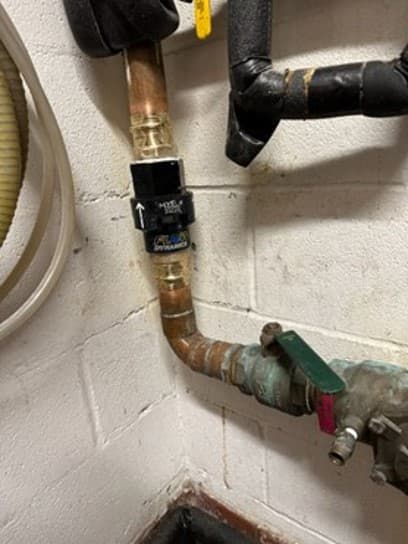
- Install Smart Valve technology — Removes air before the meter, reducing registered consumption 15-25%. Addresses the root cause of over-billing.
- Apply for sewer deductions — If you have cooling towers, irrigation, or manufacturing processes that consume water without discharge, you can reduce sewer charges significantly.
- Drop a billing tier — Even a 10% reduction in water usage can push you from Tier 3 to Tier 2, saving far more than the 10% suggests due to the rate differential.
- Fix hidden leaks — A running toilet wastes 200 gallons/day. At $12.50/kGal, that's $912/year per fixture.
- Contest meter accuracy — Request a meter test from your utility if readings seem high. Meters older than 15 years often over-register.
Frequently Asked Questions
What does CCF mean on a water bill?
CCF stands for Centum Cubic Feet, or 100 cubic feet of water. One CCF equals 748 gallons. Most commercial water utilities bill in CCF or kGal (1,000 gallons). One CCF = 0.748 kGal.
How much does water cost per CCF?
The national average commercial water rate is $5.50-$9.00 per CCF in 2026. However, rates vary dramatically by city — from $2.80/CCF in Memphis to $15.40/CCF in San Francisco. Tiered rate structures can push effective costs 2-3x higher for large consumers.
How do I convert CCF to gallons?
To convert CCF to gallons, multiply by 748. For example: 10 CCF = 7,480 gallons. To convert gallons to CCF, divide by 748. For example: 100,000 gallons ≈ 133.7 CCF.
Why is my commercial water bill so high?
Common causes: (1) Tier penalty escalation, (2) Sewer charges matching 80-100% of water usage, (3) Air in lines causing 5-15% meter over-registration, (4) Undetected leaks, and (5) Municipal surcharges for infrastructure.