Why Is My Commercial Water Bill So High? 5 Hidden Causes & How to Fix Each One
Commercial water bills averaging $3,000-$15,000/month? Air in water lines, sewer multipliers, tier penalties, meter drift, and rate hikes are the 5 most common causes. Here's how to audit and fix each one in 2026.
Key Takeaway
If your commercial water bill seems too high, you're probably right. The #1 hidden cause is air in your water lines — standard volumetric meters can't distinguish air from water, inflating bills by 15-25%. Combined with sewer charges that mirror your water usage 1:1, a 20% meter over-registration effectively becomes a 20% overcharge on both water and sewer — doubling the financial impact. A Smart Valve installed at the meter eliminates this overcharge, typically saving commercial properties $8,000-$25,000/year.
$12.50
US Avg /kGal
$22+
Cleveland /kGal
$30+
San Francisco /kGal
748
Gallons per CCF
Cause #1: Air in Your Water Lines (The Invisible Overcharge)
This is the single most common — and most fixable — cause of inflated commercial water bills. Municipal water systems pressurize water during treatment and distribution. When that pressurized water reaches your building and the pressure drops (Boyle's Law), dissolved air expands. Your water meter measures volume, not density. It counts expanded air as water.
The Math:
- • Typical over-registration: 15-25% of metered volume
- • At $12.50/kGal national average, a facility using 200 kGal/month overpays: $3,750-$7,500/year for air
- • In high-cost markets like Cleveland ($21/kGal): $7,560-$12,600/year wasted
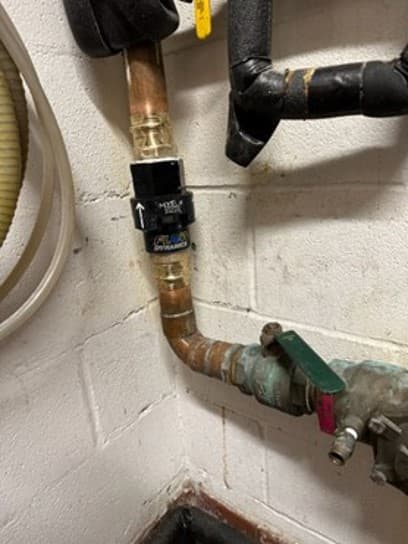
The Fix: A Smart Valve installed on the customer side of the meter compresses entrained air before it reaches the meter. The meter then reads only liquid water — the water you actually use. Third-party engineering firms (Reihl Engineering, Wylie Engineers) have validated savings exceeding 20%.
Cause #2: The Sewer Multiplier
Most commercial properties pay sewer charges based on 100% of metered water volume. Sewer rates often match or exceed water rates. This means every gallon of air your meter counts as water also gets billed as sewer discharge.
The Double-Charge Effect:
| City | Water Rate | Sewer Rate | Air Cost per 100 kGal |
|---|---|---|---|
| Cleveland, OH | $7.88 | $13.00 | $2,088 |
| Minneapolis, MN | $5.19 | $7.91 | $1,310 |
| Baltimore, MD | $11.06 | $14.11 | $2,517 |
| National Avg | $5.50 | $7.00 | $1,250 |
Cost of air per 100 kGal of over-registered volume at combined rate.
Cause #3: Tiered Rate Structures (The Volume Penalty)
Many utilities use "inclining block rates" — the more water you use, the higher the per-unit cost. If meter inaccuracy pushes your consumption into a higher tier, you're paying a premium rate for water you never used. A 10-15% reduction in metered volume through Smart Valve technology can drop you into a lower tier, compounding savings.
Example: Tiered Penalty in Action
A facility using 300 kGal/month at $10/kGal (Tier 1) pays $3,000. If meter over-registration pushes reported usage to 360 kGal and the top 60 kGal falls into Tier 2 at $15/kGal, the bill becomes $3,000 + $900 = $3,900. That's a $900/month penalty for air — $10,800/year.
How Much Are You Overpaying?
Enter your current water usage and city to see your exact savings potential — with verified 2026 rate data for 50 US metros.
Cause #4: Meter Drift & Aging Infrastructure
Water meters degrade over time. According to the American Water Works Association (AWWA), positive displacement meters — the most common type in commercial installations — tend to over-register as they age, not under-register. Internal gears wear, increasing friction and causing the meter to count more volume per unit of flow.
Additionally, aging municipal infrastructure (some US cities have water mains 100+ years old) causes pressure volatility. Pressure spikes cause meters to "over-spin," registering more volume than actually flows through. The combination of an aging meter and volatile supply pressure is the worst-case scenario for billing accuracy.
The Fix: Request a meter accuracy test from your utility. If the meter tests within tolerance but your bills still seem high, the issue is likely entrained air — which is invisible to a meter accuracy test.
Cause #5: Municipal Rate Hikes (The Unavoidable Reality)
US water and sewer rates have increased an average of 54% since 2010, according to AWWA data. In 2026 alone, major rate hikes have hit cities including:
| City | Increase | Annual Impact (300 kGal/mo) |
|---|---|---|
| Gilbert, AZ | 25% | TBD (April 2026) |
| Santa Monica, CA | 20% | +$7,884 |
| San Francisco, CA | 12.6% | +$12,312 |
| Minneapolis, MN | 11.1% (sewer) | +$3,081 |
| Baltimore, MD | 9% | +$7,488 |
You can't control rate hikes, but you can control how much volume your meter registers. Reducing metered volume by 20% offsets most rate increases — and in high-cost markets, the savings far exceed the rate hike impact. Track rate changes in your market on our WaterWatch alert feed.
Understanding Your Water Bill: CCF Explained
If your bill lists usage in CCF (centum cubic feet), here's how to translate it:
CCF Conversion Table
| CCF | Gallons | kGal | Cost @ $12.50/kGal |
|---|---|---|---|
| 1 | 748 | 0.748 | $9.35 |
| 10 | 7,480 | 7.48 | $93.50 |
| 100 | 74,800 | 74.8 | $935 |
| 500 | 374,000 | 374 | $4,675 |
| 977 | 730,696 | 730.7 | $9,134 |
977 CCF included as a common search query. For a detailed CCF guide, see our Complete Water Bill Guide.
Your 3-Step Action Plan
Step 1: Benchmark Your Costs
Calculate your cost per kGal and per square foot. If you're above $2.00/SF/year or above the national average of $12.50/kGal, you have room to save.
Step 2: Rule Out Leaks
Shut off all fixtures and check if the meter is still running. If it is, you have a leak. If it's not, the issue is likely meter inaccuracy or tiered rate penalties.
Step 3: Address the Meter
Install a Smart Valve to eliminate air from your metered volume. This addresses Causes #1, #2, and #3 simultaneously — and typically pays for itself within 8-14 months.
Find Out Exactly How Much You Can Save
Enter your current water bill or usage into our free ROI Calculator. Verified 2026 rate data for 50+ US cities.
Written by
Smart Valve Team
Published
2026-04-03