Understanding Water Meter Accuracy: Why Your Bill May Be Higher Than It Should Be
Learn how air in water lines causes meters to over-register, leading to inflated water bills. Discover the science behind the problem and how Smart Valve technology addresses it.
Key Takeaway
Water meters cannot distinguish between water and air. Air dissolved in municipal water expands when pressure drops at the meter, causing over-registration of 20% or more. Smart Valve technology prevents this air expansion, ensuring you only pay for actual water delivered.
The Hidden Problem in Every Water System
If you manage a commercial property, you likely review your water bills regularly. But have you ever wondered if those bills accurately reflect your actual water usage? The reality is that most water meters measure more than just water—they also measure air.
Municipal water systems naturally contain entrained air—microscopic bubbles dissolved in the water under pressure. This is completely normal and not a defect in your water supply. The problem arises when this water passes through your meter.
The Science: Boyle's Law in Action
Remember Boyle's Law from high school chemistry? It states that as pressure decreases, gas volume increases. This principle directly applies to your water billing.
Municipal water is delivered under high pressure—typically 60-80 PSI or more. When this water passes through your meter, there's a natural pressure drop. According to Boyle's Law, the entrained air expands as pressure decreases.
Here's the critical issue: volumetric water meters cannot distinguish between air and water. They measure total volume passing through. So expanded air gets counted as water usage—and you pay for it.
How Much Does This Actually Cost?
Studies and real-world case studies have demonstrated that air in water lines can cause meter over-registration of 20% or more. For a commercial property with a $50,000 annual water bill, that's $10,000 or more in unnecessary charges—every year.
Example: Office Building Impact
These costs compound when you consider that sewer charges are typically billed 1:1 with water usage. If your meter over-registers water by 20%, your sewer charges are also inflated by 20%.
Why Low-Flow Fixtures Don't Solve This Problem
Many property managers invest in low-flow fixtures to reduce water costs. While these do reduce actual water consumption, they don't address meter accuracy. In fact, low-flow fixtures can sometimes make the problem worse.
Low-flow fixtures often work by restricting water flow, which can create additional pressure fluctuations. These fluctuations can cause more air expansion and potential meter over-spin.
The Smart Valve Solution
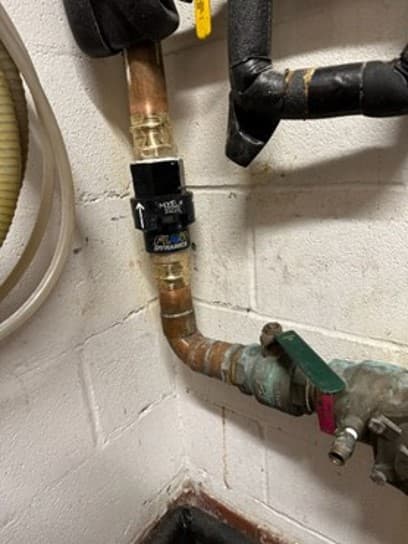
Smart Valve technology addresses the root cause of meter over-registration rather than just reducing usage. The valve is installed on the customer side of the meter and works by:
- Pressure Optimization: Maintains consistent pressure through the meter to prevent air expansion
- Flow Efficiency: Smooths water flow to reduce turbulence that contributes to meter inaccuracy
- Pressure Stabilization: Acts as a shock absorber against pressure surges from the municipal supply
Third-party engineering reviews from licensed professional engineers have validated savings in excess of 20% for commercial properties using Smart Valve technology.
Frequently Asked Questions
Why do water meters over-register?
Water meters over-register primarily because they cannot distinguish between water and air. Municipal water contains entrained air—tiny bubbles under pressure. When water enters your property and the pressure drops, this air expands. Volumetric meters measure total volume, so the expanded air counts as water usage.
How much air is typically in municipal water?
Studies have shown that entrained air can cause meter over-registration of 20% or more. The exact amount varies based on your location, municipal system age, and water pressure conditions.
Can I get my water meter calibrated?
While meters can be calibrated, calibration only ensures they measure accurately—it doesn't solve the air problem. A perfectly calibrated meter will still count air as water. The solution requires addressing air before it reaches the meter.
Next Steps
If you suspect your water bills include charges for unmeasured air, there are several steps you can take:
- Review your water bills for the past 12-24 months to understand your baseline costs
- Use our ROI Calculator to estimate potential savings
- Contact us for a free assessment of your property's savings potential
Written by
Smart Valve Team
Published
2025-01-15